lunes, 1 de octubre de 2018

Sierra College Blog Reflexion


 What do you think Sierra College will look like ten years from now and what will be the role of the online program? 


I would predict that more and more students will be taking online courses for all the reasons that we have mentioned on this course. I would say there will be more interactive software used, more online conversations happening at real time at some points during the course. This could limit a little bit the flexibility of the course since some weeks there will be compulsory life collaborative sessions happening at the same time for all the students but it will increase the social and interactive element of the course.
Having said that, those students who can allow (time, distance, transport) to go to the campuses will still choose to  --based on the course and on the schedule-- attend some on-site courses, partially to interact with the other students both in and outside the class.

lunes, 19 de febrero de 2018


Artículo muy interesante acerca de los programas bilingües en Alisal Union School District.

El artículo original, escrito por Cristian Ponce, se puede encontrar en http://www.thecalifornian.com/

Un fragmento del artículo:

Students at Monte Bella Elementary School now can get a head start by learning two languages at the same time.

The school is the first in the Alisal Union School District to implement a dual immersion program, in which children learn by being fully immersed in classes taught in two languages.

Monte Bella has two classes that are dual immersion, both for kindergarten.

"The kids in our school are learning Spanish and English at the same time but we're employing the 80:20 model, 80 percent Spanish and then 20 percent English," said Monte Bella Principal Roberto Nuñez.

The program was implemented this school year with kindergarten, and Nuñez said parents have the choice to enroll their children in one of three programs at the school. One is a regular all-day English-taught class, the second is a structured English immersion class that is the opposite of the regular dual immersion with 20 percent Spanish taught and the third being the traditional dual immersion, said Nuñez.

“You’re talking to the parents, asking 'What is it that you want for your kids at the end of high school graduation?'” said Nuñez. “Do you want them to be monolingual, bilingual? Do you want them to go to college? They’re not really thinking about the high school but they need to because this decision that they make right then and there will affect that trajectory of that path.”


jueves, 8 de febrero de 2018

National University --Teaching Credential --Ted 633


My name is Hugo Díaz. I teach five Spanish courses and also soccer in a high school that is part of the Expeditionary Learning web. I am passionate about teaching my native language and help people develop multicultural skills. I am also one of the managers on the Spanish department of PandaTree, an online language learning platform for K-12.

I am currently expanding my knowledge of and implementing:

- Seal of Biliteracy.
- Dual Language Education Programs and cross-cultural competence.
- Second-language immersion programs.
- Motivation (intrinsic and extrinsic) of American students of Spanish.
- Blended learning: rotation model (Station Rotation, Lab Rotation, Flipped Classroom, and Individual Rotation), flex model, à la carte, enriched virtual.
- Virtual education.
- Literacy Design Collaborative.
- How to teach and transmit character: grit, zest, self control, gratitude, optimism. Constructive responding / Growth mindset / Character behavior language.
- Dual purpose lesson (academic and character goal).
- Cultura Sefardí, relaciones español-ladino.
- Language minority students.
- Communication needs in the health / medical field.
- Language planning in the legal domain (courtroom) and prevent language inadequacy.
- Spanish in the workplace.
- Cross cultural understanding.
- Culturally sensitive classrooms.
- Intergenerational language maintenance-shift-loss / diglossia / code switching.
- Implementing strategies to help low achievers, providing equal opportunities for all learners.


How did your personality affect your choice of content area?

The results of the MMDI questionnaire show that I am more on the extraversion side than on the introversion. Regardless of what your predominant motivation to learn a second language is mostly (intrinsic, extrinsic, integrative), you need to be ready to interact and communicate with other students and speakers of that language.
I was first interested in languages when I started learning French at school and later on English. Years later,  living on the Mediterranean coast of Spain, I found fascinating being able to communicate and  learn about the countries, traditions and cultures of the tourists visiting the area. The only way to do it was communicating in my English or French and in Spanish. Later on, once studying at university, I used to help with their Spanish (and Catalan) my foreign flatmates and foreign students who were friends of mine. As a native Spanish speaker and being able to speak French and English I was able to talk to people from all over the world, in Barcelona or when  traveling around Europe.
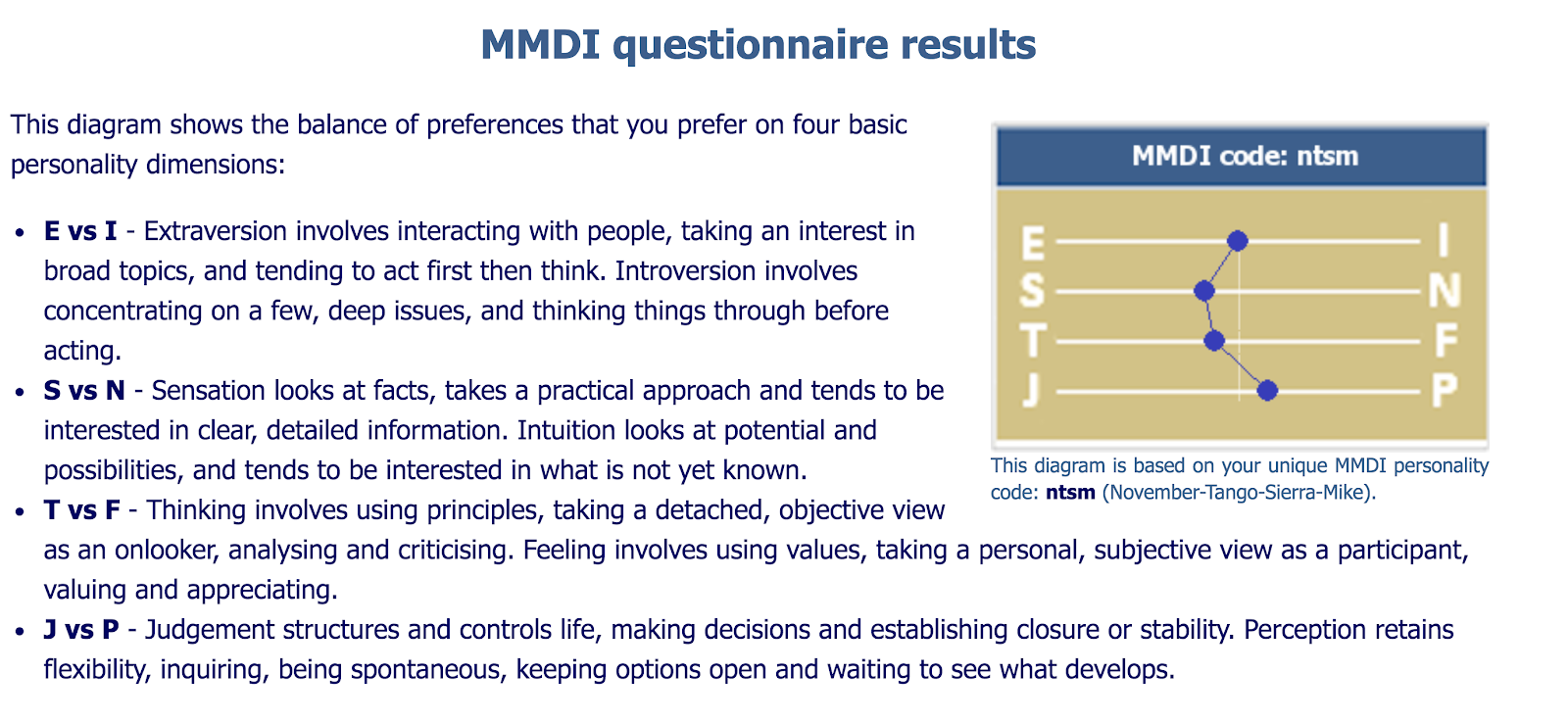


Results show that I am more on the “sensation” component than on the “intuition” component. That is something that has been changed over the last years. As an non-native English speaker who in a short amount of time has had to do tons of procedures and paperwork of all kinds, involving multiple steps, and receiving explanations from different people in my L4, I have realized the importance of “clear and detailed information” rather than vague and confusing explanations and not assuming that people already know things.

Next, I am more into perception than its counterpart  “judgement structures”, I agree with the “flexibility, inquiring, being spontaneous” are characteristics of a world language teacher. Finally, I scored closer to the “thinking” than to the “feeling”. Research shows that bilingual children develop empathy faster than monolingual kids, and that adults learning a second language approach problems in a more rational way when doing it in their L2.


How does or will your personality affect your relationships with your students?

I make sure I provide clear directions which I provide orally and written, I also provide examples of the tasks students need to complete. Since I take “an interest in broad topics”, in my classes I make connections to other subjects and include meaningful topics to engage students. Although I carefully plan my lessons and add several options I am flexible and I can readily change the path depending on the class reactions and interests (“keeping options open and waiting to see what develops”).


How will your teaching and learning style affect your teaching and your students' abilities to be successful?

Since I am aware that in a class students have different predominant learning styles, I plan my lessons and implement them having that variety in mind. I plan so that my lessons have different activities that cover all learning styles and even within each activity/task students have the option of acquiring the content and demonstrating mastery in different ways. I adhere to the Universal Design approach.


miércoles, 13 de diciembre de 2017

Global Ed Seal of Biliteracy 2017 (by Deirdre Garcia)

What is the Seal of Biliteracy, how do you earn it?

What this video by Deirdre Garcia.


More interesting videos:
Californians Together Presents: The Seal of Biliteracy -- Celebrating Students of the 21st Century.


Seal of Biliteracy Hoover Elementary with Spanish Subtitles.


miércoles, 15 de marzo de 2017

Report: Want the Job? Be Able to Say So in More than One Language

Read the article by Carmen Cusido on NBC News Report: Want the Job? Be Able to Say So in More than One Language      

Some excerpts from the article:

«Those looking for a job may want to emphasize their language skills. In the last five years,the demand for employees in the United States who know more than one language has more than doubled, according to a report recently released by the New American Economy.

"In today's global economy, businesses require employees who can serve customers in a variety of languages," John Feinblatt, chairman of New American Economy, said in a prepared statement. "This research highlights the growing need to attract and promote a multilingual workforce among both foreign- and U.S.-born talent."
Marco López, the executive vice president for client services at elemento L2, a Chicago-based multicultural marketing agency, said of the company's 15 employees, only two or three are not bilingual and two are not bicultural.

"Not being bilingual is not a deal breaker for us, but it is an extra added value that you (bring) to the table," López told NBC News.»

domingo, 26 de febrero de 2017

Enlace a la entrada del blog de Marcos Villa acerca de famosos hablando español.

Enlace a la entrada del blog de Marcos Villa acerca de famosos hablando español (link).

Foto del blog de Marcos Villa (¡la foto no es un enlace a los vídeo!).

AIL Málaga: 10 razones para aprender español

En este artículo, AIL Málaga nos da 10 razones para aprender español.


"The multilingual brain might actually be better at doing business than the monolingual brain”


“The multilingual brain might actually be better at doing business than the monolingual brain,” says Antonella Sorace, professor of developmental linguistics at the University of Edinburgh.
Multinational companies have long recognised the functional benefits of multilingualism as a bridge between business cultures. Not speaking other languages may even be a block to promotion these days, according to early findings from the British Academy’s Born Global research into language policy in the UK.


“Maybe we are starting to see the first effects of people trying to avoid the risk factors. Bilingualism doesn’t make you immortal, it doesn’t cure dementia but it delays it. In stroke patients twice as many people in the bilingual group recovered their cognitive abilities completely after a stroke than monolinguals. The bilingual brain is better equipped to cope with the damage.” Thomas Bak.

domingo, 21 de agosto de 2016


From Early Childhood Education Zone: http://www.earlychildhoodeducationzone.com/why-your-kids-should-learn-a-second-language/      


Pictures from the webpage:


domingo, 8 de mayo de 2016

As Utah’s first dual-immersion students are prepping for college, so is their language program


Artículo de Benjamin Wood publicado el 8 de mayo en la edición digital de "Salt Lake Tribune". (link to the whole article at Salt Lake Tribune)

Read some excerpts from the article:

«Campos said her students need to keep practicing to improve their Spanish fluency. But she added that she was and continues to be impressed with their confidence and mastery in the language.
"They're ready to study any subject in Spanish," she said. "They could travel abroad, work and they won't have any problem."


Beyond Spanish, Utah students in schools around the state are immersed in French, Chinese, Portuguese and German. Roberts said immersion programs are now at 20 percent of elementary schools, and the state continues to launch immersion programs at 20 to 25 new schools each year.[...] While dual immersion exists in some urban school districts and metropolitan areas, Utah is a national leader for its statewide program.»
«It's a feather in the state's cap that generates attention for education managers and policymakers, like in 2013, when Roberts was quoted in Time magazine saying that "monolingualism is the illiteracy of the 21st century."» 
«Utah students are competing for jobs against students in Asia, Europe, Latin America — the world — and guess what? Those kids aren't monolingual," he said. "It's not the future. Most people in the world are multilingual.»
«Roberts said he felt like a used-car salesman in the early days of the program, holding informational meetings around the state asking parents to enroll their children.
"Now I don't even do any more parent PowerPoints," he said. "We just open a [immersion] school and it's full overnight."»


viernes, 22 de abril de 2016


Link to the article:

Bilingual battle brewing in California…again 

 Article by Lillian Mongeau in the Hechinger Report.

Here is an excerpt:
«Research that was not available when Prop 227 first passed now shows that the effort involved in offering such programs could have a big payoff. One study, out of Stanford University, found that it took children learning English in dual language programs longer to master the language than those who learned English in an English immersion program. However, by the end of middle school, the students from the dual language immersion programs were doing better in English and earning higher grades in other subjects, while graduates of English immersion programs often reached a plateau in English and performed consistently worse in other subject areas.»


jueves, 3 de diciembre de 2015

Bilingual education in Georgia: World Language Academy in Georgia.


Article by Dan Carsen for PRI, about World Language Academy in Georgia.

Here you can read an excerpt:

«She’s learned a lot about cultures and about bilingual education since then. Her students’ (and the whole school's) test scores are very good, even though the tests are in a language in which her kids are taught just half the time:

“My students are on third-grade reading levels here, but they’ve only really gotten half of their day in [English], and they’re still meeting – actually more or less exceeding – where they’re supposed to be,” she says.»

jueves, 26 de noviembre de 2015

Acerca del día de Acción de Gracias (Thanksgiving)

Artículo en el periódico español ABC (escrito por César Cervera) acerca de la significación del Día de Acción de Gracias, datos históricos sobre los acontecimientos de los primeros colonos españoles e ingleses y otros detalles sobre la presencia europea en las tierras actuales de EE.UU.


domingo, 11 de octubre de 2015

Conoce España 1

Historia de España, el Castillo de Loarre.

Artículo (Misterios en el castillo de Loarrede Mónica Arrizabalaga  en el periódico ABC  acerca de la publicación del libro «El Castillo» de Luis Zueco.

Misterios en el castillo de Loarre
Fotografía de Fabián Simón, en ABC.

Aquí os dejo unos fragmentos del artículo:

«Loarre es el prototipo de los castillos de España», explica este novelista e historiador, vicepresidente de la Asociación de Amigos de los Castillos de Aragón. «Aquí no tenemos los castillos del Loira o el Rhin, más palaciegos. Los nuestros son castillos militares, que es para lo que realmente servía un castillo, y si se piensa en un castillo militar, Loarre cumple con todos los requisitos de lo que es un castillo español», añade el escritor que explica cuáles son estas características. La primera, «una ubicación que al verlo dices: ¡madre de Dios, cómo lo pudieron construir allí!», la cumple Loarre con creces. A mil metros, en la montaña pirenaica, es un nido de águilas, un lugar estratégico que podría defenderse hasta sin castillo como de hecho ocurre en la novela.

Los muros, pasadizos y salas de este castillo, donde se rodó parte de la película de «El reino de los cielos» de Ridley Scott, se mantienen hoy tal y como estaban en el siglo XI,sin luz eléctrica ni paneles informativos. Un lugar donde resulta fácil imaginar a Eneca, Fortún y la multitud de personajes de esta novela histórica de Zueco, que abarca el periodo en que se levantó la fortaleza, entre el año 1027 y el 1082.


Cerca del Castillo de Loarre, Murillo de Gállego:


Resultado de imagen para murillo de gallego Resultado de imagen para murillo de gallego


Desde el Castillo de Loarre, a 1 hora y 10 minutos en coche encontramos Alquézar:

Resultado de imagen para alquézar  Resultado de imagen para alquézar


sábado, 10 de octubre de 2015

Dual-Language Programs Are on the Rise, Even for Native English Speakers

Dual Language Programs becoming more popular in the U.S. Read this article by Elizabeth A. Harris published in The New York Times online edition.

Here you have some extracts from the article: 

I want two things,” said Gov. Jack Markell of Delaware, a Democrat. “I want students from Delaware to be able to go anywhere and do any kind of work they want to do, and I also want to attract businesses from around the world, to say, ‘You want to be in Delaware because, amongst other things, we’ve got a bilingual work force.’ ”

"For native English speakers, there is relatively little research on how dual-language programs affect their performance on standard metrics like state tests.
But Jennifer Steele, an associate professor at American University’s School of Education who is finishing research on Portland’s dual-language programs, said her work had found performance increases for both native English speakers and English-language learners in some grades and certain subjects once they reached late elementary school."

«[...] “If you set the tone from the beginning, then they kind of know, ‘Hey, I’m going to get it in just a second, let me see what she’s doing,’ ” Ms. Menendez said. “They are sponges. They start attuning.”
To help them along, language at Dos Puentes is color-coded, especially in the lower grades. In one classroom, a label near a jar of pencils read “sharpener” in royal blue and “sacapunta” in fire engine red. On a poster, the words “read quietly” had a blue border and “leo en voz baja” a red one. As a kindergarten teacher sang in Spanish with her students, she made sure to use a red marker as she wrote on a dry erase board.»

«Sean Reardon, a professor at Stanford University’s Graduate School of Education who has researched dual-language programs, said there might also be a difference depending on what two languages are being taught. While Spanish and English are phonologically similar, sharing an alphabet and many sounds, character-based languages like Chinese are quite different, he said, and that might make it more difficult for students to follow along.»


domingo, 20 de septiembre de 2015

Hispanic Heritage Month: The Foundation of America's Civil Rights Movement


Read the article Hispanic Heritage Month: The Foundation of America's Civil Rights Movementby Stephen Balkaran, Professor of Political Science.

An extract from the article:

«As anti-Hispanic rhetoric continues; it has taken away the best of who we are and what we can become as a nation and Americans. The immigration debate has now generated so many divisions in our society that it has become the "civil rights debate of 21st Century." Never in American history has an issue divided a nation of immigrants but more so left us scrambling for our true national identity. Civil Rights remain the pinnacle of debates, the protection of rights for all Americans, regardless of color, race, gender, age, sexual orientation and defending these rights against discrimination have long been important issue for all Americans. The Civil Rights Act of 1964, arguably one of the most important pieces of legislation in our country's history which ensured that legal barriers be torn down; which theoretically, should have eliminated barriers of discrimination against all Americans in our society. Despite this important legislation very few understand the historical foundations of the modern-day civil rights movement and the Hispanic influence. »


viernes, 17 de julio de 2015

Lee el artículo en español de "La Razón" (a su vez procede de Europa Press) titulado «Los bilingües tienen más materia gris en el cerebro», acerca de los hallazgos realizados en el estudio Neuroanatomical Evidence in Support of the Bilingual Advantage Theory (in English).


Te recomendamos además el vídeo  «The benefits of a bilingual brain», por Mia Nacamulli, en el canal de Youtube TED-Ed.


domingo, 12 de julio de 2015

Read the article Hispanic Heritage Month: How Hispanics Are Defining and Redefining America by Stephen Balkaran, Professor of Political Science at Quinnipiac University. Article published on Huffington Post.

Read these extracts from the article (the underline has been added by me, it is not part of the original article):


« During the American Revolutionary War, Bernardo de Galvez, governor of the Louisiana Territory, sent gunpowder, rifles, bullets, blankets, medicine and other supplies to the armies of General George Washington in support of America's cause. Once the war began, Galvez, along with support and reinforcements from Spain's Cuba, Mexico and Puerto Rico.
What would our country's political history be without Hispanics? What would Manifest Destiny and America's expansion be without the role of Hispanics and the carving of America's great Western frontier? The Hispanic presence in the election of President James Polk in 1844 and his future policy of annexation of Texas, the stolen land, the creation of the artificial border, the Alamo, the great Southwest, and the Compromise of 1850 all help define our American history. What would America be like without the importance of The Treaty of Guadalupe Hidalgo, which ended the Mexican War, where the United States gained not only Texas, New Mexico and Upper California, making way for the vast expansion of American land, but also a cultural history like no other? Our Civil War would not be the same without the presence of Hispanics, often removed from our history books. Some 20,000 Hispanics fought in the Civil War, some serving in the 1st Florida Cavalry, others serving in the Union forces in Connecticut, New York and Massachusetts. From the first battle in Fort Sumter to the last battle in Palmito Ranch, Texas, their allegiance served in America's defining war over the issue of slavery. Hispanics have always met the challenge of serving America with commitment and admiration in the midst of the great American Split. »