
domingo, 10 de enero de 2016

jueves, 3 de diciembre de 2015
Bilingual education in Georgia: World Language Academy in Georgia.
Article by Dan Carsen for PRI, about World Language Academy in Georgia.
Here you can read an excerpt:
«She’s learned a lot about cultures and about bilingual education since then. Her students’ (and the whole school's) test scores are very good, even though the tests are in a language in which her kids are taught just half the time:
“My students are on third-grade reading levels here, but they’ve only really gotten half of their day in [English], and they’re still meeting – actually more or less exceeding – where they’re supposed to be,” she says.»
jueves, 26 de noviembre de 2015
Acerca del día de Acción de Gracias (Thanksgiving)
Artículo en el periódico español ABC (escrito por César Cervera) acerca de la significación del Día de Acción de Gracias, datos históricos sobre los acontecimientos de los primeros colonos españoles e ingleses y otros detalles sobre la presencia europea en las tierras actuales de EE.UU.

domingo, 11 de octubre de 2015
Conoce España 1
Historia de España, el Castillo de Loarre.
Artículo (Misterios en el castillo de Loarre) de Mónica Arrizabalaga en el periódico ABC acerca de la publicación del libro «El Castillo» de Luis Zueco.
Fotografía de Fabián Simón, en ABC.
Aquí os dejo unos fragmentos del artículo:
«Loarre es el prototipo de los castillos de España», explica este novelista e historiador, vicepresidente de la Asociación de Amigos de los Castillos de Aragón. «Aquí no tenemos los castillos del Loira o el Rhin, más palaciegos. Los nuestros son castillos militares, que es para lo que realmente servía un castillo, y si se piensa en un castillo militar, Loarre cumple con todos los requisitos de lo que es un castillo español», añade el escritor que explica cuáles son estas características. La primera, «una ubicación que al verlo dices: ¡madre de Dios, cómo lo pudieron construir allí!», la cumple Loarre con creces. A mil metros, en la montaña pirenaica, es un nido de águilas, un lugar estratégico que podría defenderse hasta sin castillo como de hecho ocurre en la novela.
Los muros, pasadizos y salas de este castillo, donde se rodó parte de la película de «El reino de los cielos» de Ridley Scott, se mantienen hoy tal y como estaban en el siglo XI,sin luz eléctrica ni paneles informativos. Un lugar donde resulta fácil imaginar a Eneca, Fortún y la multitud de personajes de esta novela histórica de Zueco, que abarca el periodo en que se levantó la fortaleza, entre el año 1027 y el 1082.
Cerca del Castillo de Loarre, Murillo de Gállego:


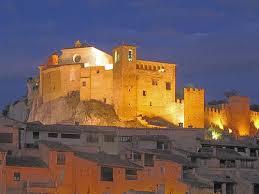

Cerca del Castillo de Loarre, Murillo de Gállego:
Desde el Castillo de Loarre, a 1 hora y 10 minutos en coche encontramos Alquézar:
sábado, 10 de octubre de 2015
Dual-Language Programs Are on the Rise, Even for Native English Speakers
Dual Language Programs becoming more popular in the U.S. Read this article by Elizabeth A. Harris published in The New York Times online edition.
Here you have some extracts from the article:
“I want two things,” said Gov. Jack Markell of Delaware, a Democrat. “I want students from Delaware to be able to go anywhere and do any kind of work they want to do, and I also want to attract businesses from around the world, to say, ‘You want to be in Delaware because, amongst other things, we’ve got a bilingual work force.’ ”
"For native English speakers, there is relatively little research on how dual-language programs affect their performance on standard metrics like state tests.
But Jennifer Steele, an associate professor at American University’s School of Education who is finishing research on Portland’s dual-language programs, said her work had found performance increases for both native English speakers and English-language learners in some grades and certain subjects once they reached late elementary school."
«[...] “If you set the tone from the beginning, then they kind of know, ‘Hey, I’m going to get it in just a second, let me see what she’s doing,’ ” Ms. Menendez said. “They are sponges. They start attuning.”
To help them along, language at Dos Puentes is color-coded, especially in the lower grades. In one classroom, a label near a jar of pencils read “sharpener” in royal blue and “sacapunta” in fire engine red. On a poster, the words “read quietly” had a blue border and “leo en voz baja” a red one. As a kindergarten teacher sang in Spanish with her students, she made sure to use a red marker as she wrote on a dry erase board.»
«Sean Reardon, a professor at Stanford University’s Graduate School of Education who has researched dual-language programs, said there might also be a difference depending on what two languages are being taught. While Spanish and English are phonologically similar, sharing an alphabet and many sounds, character-based languages like Chinese are quite different, he said, and that might make it more difficult for students to follow along.»
domingo, 20 de septiembre de 2015
Hispanic Heritage Month: The Foundation of America's Civil Rights Movement
Read the article Hispanic Heritage Month: The Foundation of America's Civil Rights Movement, by Stephen Balkaran, Professor of Political Science.
An extract from the article:
«As anti-Hispanic rhetoric continues; it has taken away the best of who we are and what we can become as a nation and Americans. The immigration debate has now generated so many divisions in our society that it has become the "civil rights debate of 21st Century." Never in American history has an issue divided a nation of immigrants but more so left us scrambling for our true national identity. Civil Rights remain the pinnacle of debates, the protection of rights for all Americans, regardless of color, race, gender, age, sexual orientation and defending these rights against discrimination have long been important issue for all Americans. The Civil Rights Act of 1964, arguably one of the most important pieces of legislation in our country's history which ensured that legal barriers be torn down; which theoretically, should have eliminated barriers of discrimination against all Americans in our society. Despite this important legislation very few understand the historical foundations of the modern-day civil rights movement and the Hispanic influence. »
viernes, 17 de julio de 2015
Lee el artículo en español de "La Razón" (a su vez procede de Europa Press) titulado «Los bilingües tienen más materia gris en el cerebro», acerca de los hallazgos realizados en el estudio Neuroanatomical Evidence in Support of the Bilingual Advantage Theory (in English).
Te recomendamos además el vídeo «The benefits of a bilingual brain», por Mia Nacamulli, en el canal de Youtube TED-Ed.
Suscribirse a:
Entradas (Atom)